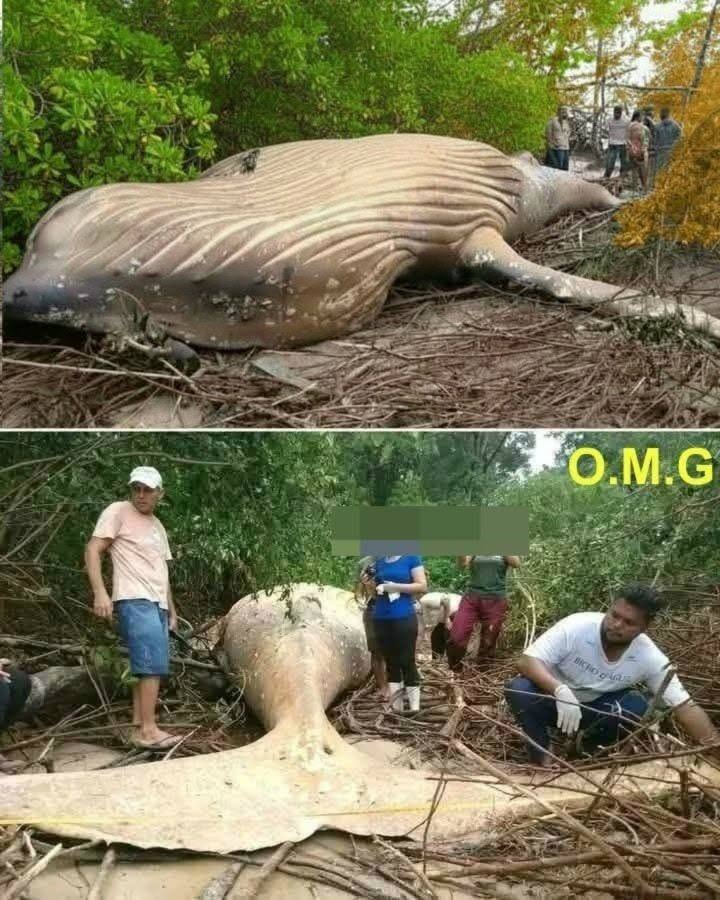
Scientists Search for Answers
ADVERTISEMENT
Marine biologists and environmental specialists carefully examined the animal and surrounding area.
After studying local conditions, researchers proposed a likely explanation.
According to experts, powerful seasonal tides and strong ocean currents may have carried the young whale inland during a period of unusually high water levels.
ADVERTISEMENT
As the tide retreated, the whale was left stranded in an area that later became isolated from the shoreline.
Unable to return to deeper water, the young animal ultimately perished.
While the explanation is grounded in natural processes, the image of a whale resting among tropical trees remains one of the most unusual wildlife discoveries in recent memory.
Understanding Humpback Whale Migration
The whale involved in the incident was identified as a young member of the species known as the Humpback Whale.
These remarkable marine mammals are famous for their long-distance migrations.
Every year, humpback whales travel thousands of miles between feeding grounds and breeding areas, making them some of the world’s most impressive migratory animals.
Young whales can sometimes become separated from their normal routes due to:
- Strong ocean currents
- Illness or weakness
- Extreme weather conditions
- Navigational challenges
- Natural environmental changes
Scientists believe one or more of these factors may have contributed to this unusual event.
What Happened to the Whale?
After completing their investigation, authorities determined that moving the carcass would be extremely difficult due to the location and size of the animal.
Instead, nature was allowed to take its course.
Over time, the whale’s remains would naturally decompose, providing valuable information for researchers studying marine life and environmental conditions.
Eventually, the skeleton was expected to be preserved for scientific and educational purposes, allowing future generations to learn from this remarkable discovery.
Why This Story Captured Worldwide Attention
The image of a giant marine mammal resting among jungle vegetation sparked curiosity around the world.
Part of the fascination comes from the contrast itself.
Whales symbolize the vast ocean, while dense forests represent an entirely different ecosystem. Seeing the two unexpectedly combined creates a scene that feels almost impossible.
Yet events like this remind us that nature is often more surprising than we imagine.
Lessons from an Extraordinary Discovery
Although scientists were able to provide a likely explanation, the whale’s appearance in such an unusual setting continues to fascinate people years later.
The incident highlights:
- The power of natural forces
- The complexity of coastal ecosystems
- The challenges faced by marine wildlife
- The importance of environmental research
- How much there is still to learn about the natural world
Even in an age of satellites, advanced technology, and global communication, nature continues to produce events that leave us amazed.
Frequently Asked Questions
Where Was the Whale Found?
The whale was discovered on Marajó Island, a large island located near the mouth of the Amazon River in Brazil.
What Type of Whale Was It?
Researchers identified the animal as a young humpback whale.
How Far Was It From the Water?
Reports indicated that the whale was found approximately 15 meters (50 feet) from the shoreline.
Did Scientists Know Exactly How It Got There?
While no one witnessed the event, experts believe powerful tides and ocean currents likely carried the whale inland before the water receded.
Final Thoughts
The discovery of a young humpback whale deep within the vegetation of Marajó Island remains one of the most remarkable wildlife stories of recent years. What initially appeared to be an unsolvable mystery ultimately highlighted the immense power of nature and the unpredictable forces that shape our world.
Sometimes the most extraordinary discoveries are not found in unexplored places—but in familiar landscapes where nature briefly reminds us that it still holds many surprises.
ADVERTISEMENT